How it works
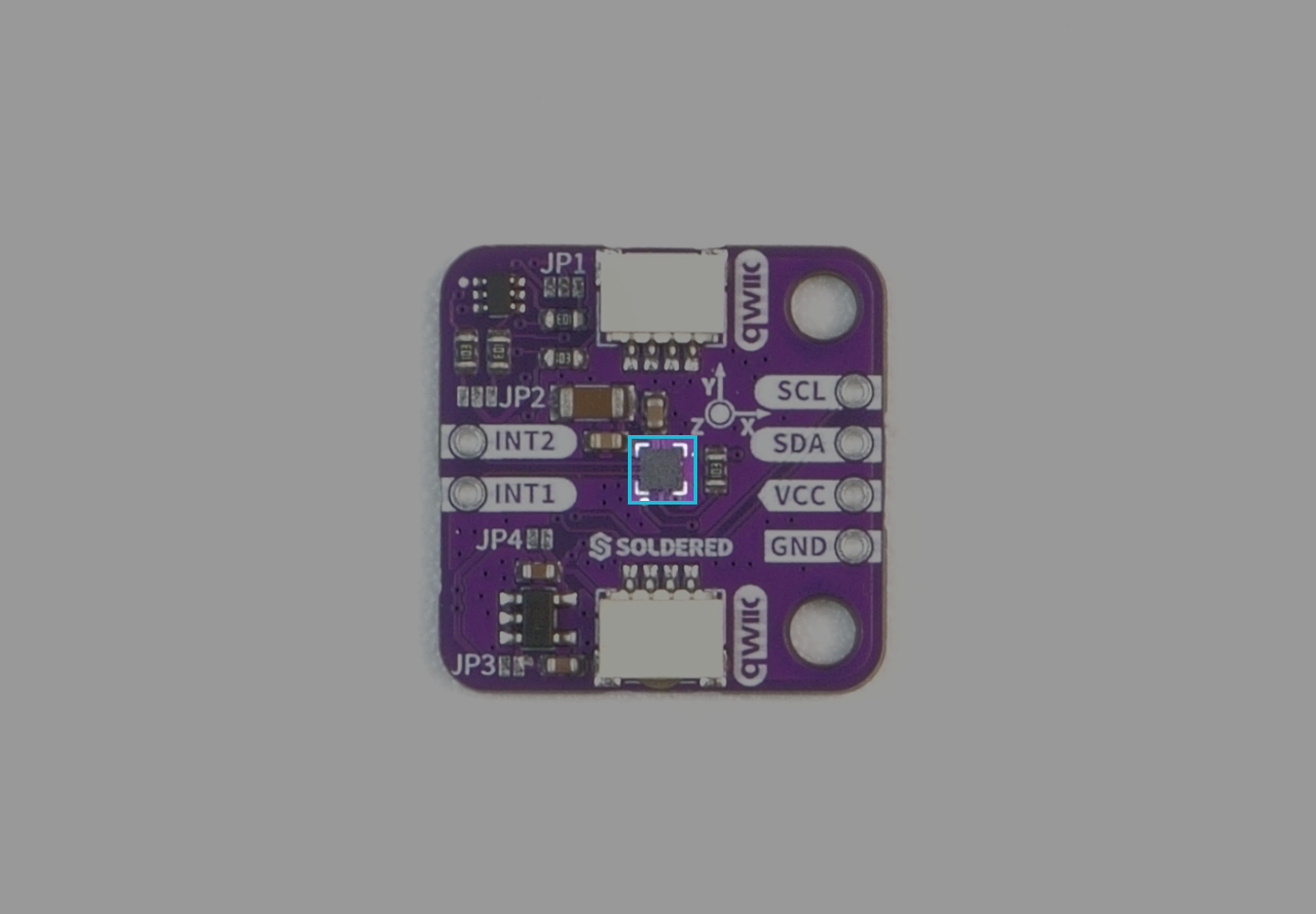
The IIS2DULPX is a MEMS accelerometer IC by STMicroelectronics. It integrates a 3-axis digital accelerometer and a QVAR (charge variation) sensing channel in a single ultra-low-power package, making it well-suited for wearables, IoT nodes, and industrial applications.
Datasheet
For an in-depth look at technical specifications, refer to the official IIS2DULPX datasheet:
IIS2DULPX Datasheet
Detailed technical documentation for the IIS2DULPX ultra-low-power accelerometer
How the accelerometer works
The accelerometer measures linear acceleration using a tiny proof mass suspended by springs inside the MEMS structure. When the device experiences acceleration, the proof mass displaces relative to its frame due to inertia, compressing or stretching the springs. This displacement is detected by capacitive sensing elements, which convert the mechanical movement into electrical signals. The signal is then digitized and made available over I2C.
The IIS2DULPX supports four selectable full-scale ranges — ±2g, ±4g, ±8g, and ±16g — with corresponding sensitivities from 0.061 mg/LSB to 0.488 mg/LSB. Three power modes are available to trade off noise performance against current draw:
| Power Mode | Available ODR |
|---|---|
| Ultra Low Power | 1.6 Hz, 3 Hz, 25 Hz |
| Low Power | 6 Hz – 800 Hz |
| High Performance | 6 Hz – 800 Hz |
How QVAR sensing works
QVAR (Quasi-Vectorial Acceleration and charge vaRiation) is an additional sensing channel embedded in the IIS2DULPX. It measures changes in electric charge on the sensor's dedicated analog input pin. This enables applications such as:
- Capacitive touch detection (e.g., detecting a finger press)
- Liquid level sensing
- Electric field variation detection
The QVAR gain is configurable with multipliers of 0.5×, 1×, 2×, or 4× relative to the base gain of 74.4 LSB/mV.
On-chip motion detection features
The IIS2DULPX includes a powerful set of embedded event-detection algorithms that run independently on the sensor, offloading the host microcontroller:
| Feature | Description |
|---|---|
| Wake-up | Triggers an interrupt when acceleration exceeds a threshold |
| Free-fall | Detects when the sensor is in free-fall |
| Tap / Double Tap | Recognizes single or double-tap gestures |
| 6D / 4D Orientation | Detects the board's orientation in 6 or 4 directions |
| Step counter | Counts steps using the embedded pedometer |
| Tilt detection | Detects when the device is tilted beyond a threshold |
| Sleep detection | Detects when the device has been stationary for a set time |
These events can be routed to either of the two interrupt pins (INT1 or INT2).
I2C communication
The Soldered IIS2DULPX breakout communicates with a microcontroller over I2C. The I2C address is 0x18 (SDO/SA0 pulled low on the board).
The library initializes I2C communication automatically through the Wire library. Upon initialization, the sensor:
- Disables I3C interface and configures BDU (block data update)
- Sets FIFO to bypass mode
- Defaults to High Performance power mode at 100 Hz ODR with ±2g full scale
Measurement process
-
Initialization
- Call
sensor.begin()to configure the sensor, disable I3C, set BDU, and prepare the FIFO. - Call
sensor.Enable_X()to power on the accelerometer.
- Call
-
Taking a measurement
- Call
sensor.Get_X_Axes(&accel)to retrieve acceleration in mg (milli-g) for all three axes. - Alternatively, call
sensor.Get_X_AxesRaw(&raw)for the 16-bit raw ADC values.
- Call
-
Event detection
- Configure an interrupt (e.g.,
Enable_Wake_Up_Detection(IIS2DULPX_INT1_PIN)) and attach an ISR to the INT pin. - Poll
sensor.Get_X_Event_Status(&status)inside the ISR handler to identify which event triggered.
- Configure an interrupt (e.g.,
-
Power management
- Use
Set_X_OutputDataRate_With_Mode(odr, power_mode)to balance performance vs. power consumption. - Call
sensor.Disable_X()to put the accelerometer into power-down when not in use.
- Use