Inputronic Keyboard - How it works
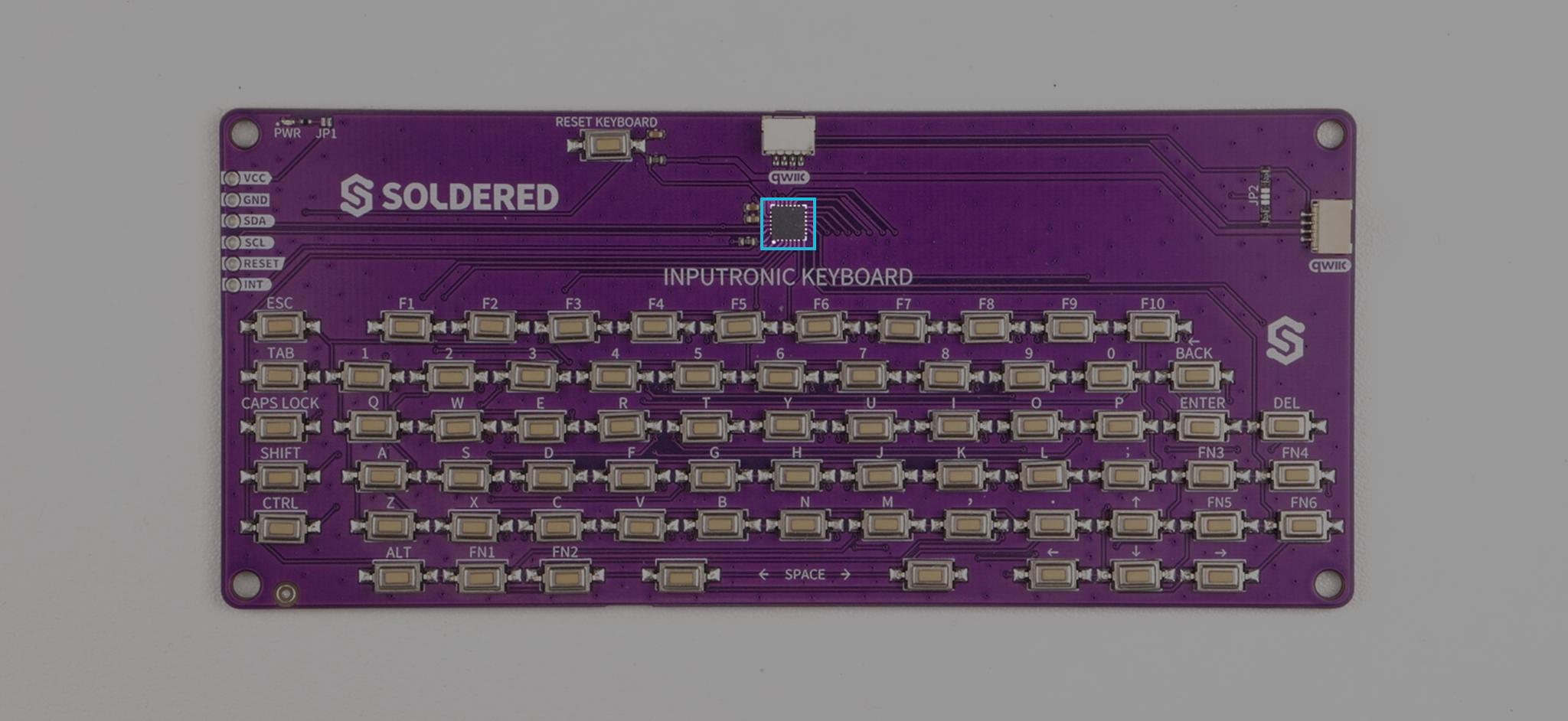
The Inputronic Keyboard is built around the TCA8418 chip by Texas Instruments. When using our board, you are essentially communicating with the onboard TCA8418 directly via I²C communication.
Datasheet
For an in-depth look at technical specifications, refer to the official TCA8418 Datasheet
TCA8418 Datasheet
Detailed technical documentation for the TCA8418 keypad scanner
How the scanner works
The TCA8418 is a keypad scanning controller that continuously monitors a matrix of buttons arranged in rows and columns. The chip configures column pins as outputs (driven low) and row pins as inputs with internal pull-up resistors. When a key is pressed, it creates an electrical connection between a row and column, pulling the row input low and alerting the chip to scan the matrix. The scanner then systematically drives one column at a time while reading all row inputs to determine exactly which key was pressed. Each key press and release is automatically debounced using a 50 µs hardware filter and stored in a 10-event FIFO buffer along with whether it was a press or release. The chip generates an interrupt signal to notify your microcontroller that key events are ready to be read via I²C, allowing efficient event-driven operation without constant polling.
I²C communication
The Inputronic Keyboard uses the I²C protocol to communicate with the microcontroller. It operates with a fixed I²C address of 0x34. Upon request, the chip responds with key event data from its FIFO buffer, including which key was pressed or released. The board supports I²C speeds up to 1 MHz (Fast Mode Plus), but you can use our library to interface with it more easily.
Key Features Explained
Event FIFO
The 10-byte FIFO stores key press and release events. Each event contains:
- Key value (7 bits): Which key was pressed (1–80 for matrix keys, 97–114 for GPIO)
- Press/Release flag (1 bit): Indicates whether the key was pressed (1) or released (0)
The FIFO automatically shifts as you read events, making it easy to process multiple key presses in sequence.
Hardware Debouncing
Mechanical switches naturally "bounce" when pressed, creating multiple electrical signals for a single press. The TCA8418 includes integrated hardware debouncing with a 50 µs filter that eliminates these false signals, ensuring each key press is registered only once.
Keypad Lock/Unlock
The chip includes a programmable security feature that requires a two-key sequence to unlock:
- Program two specific unlock keys
- Set the time window between key presses (0–7 seconds)
- Optionally configure an interrupt mask timer for LCD backlight control
This feature is useful for implementing device security or preventing accidental key presses.
Power Efficiency
The TCA8418 is designed for battery-powered applications:
- Idle mode: 10 µA when waiting for key press
- Active scan: 50–90 µA during key scanning
- Sleep mode: 3 µA in deep sleep
The internal oscillator automatically turns off when no keys are pressed, minimizing power consumption.