Hardware details
Pinout
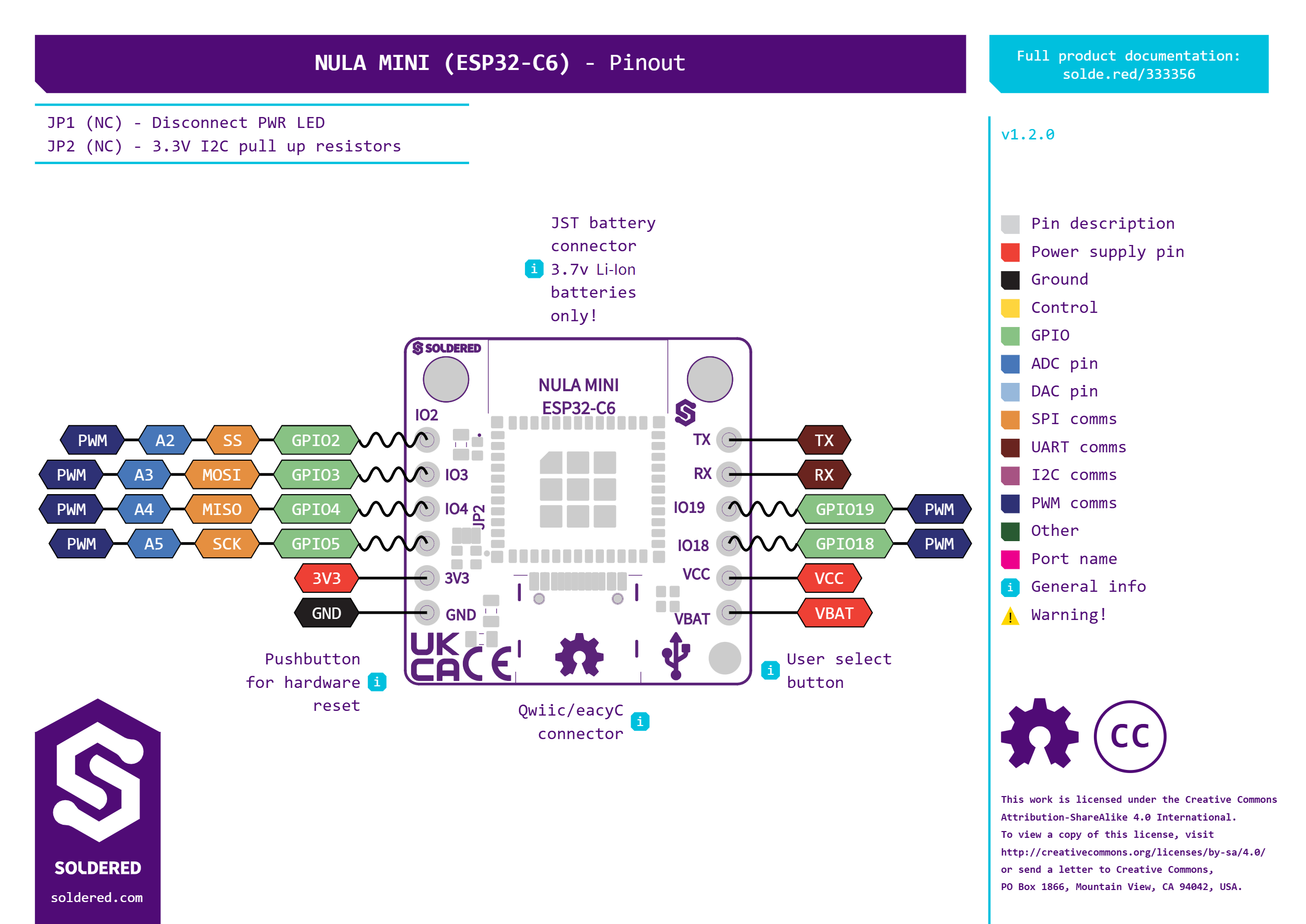
Click here for a high-resolution image of the pinout.
Pin Details
| Pin Marking | Pin Name | Description |
|---|---|---|
| VBAT | Power | Battery input for 3.7 V Li-Ion/Li-Poly battery through the JST connector. |
| VCC | Power | Main power input (5 V via USB-C or external 5 V supply). |
| 3V3 | Power | Regulated 3.3 V output from the onboard regulator. |
| GND | Ground | Common ground for power and signals. |
| IO2 | GPIO | General-purpose I/O pin, supports PWM. |
| IO3 | GPIO | General-purpose I/O pin, SPI MOSI function available. |
| IO4 | GPIO | General-purpose I/O pin, SPI MISO function available. |
| IO5 | GPIO | General-purpose I/O pin, SPI SCK function available. |
| IO18 | GPIO | General-purpose I/O pin, supports PWM. |
| IO19 | GPIO | General-purpose I/O pin, supports PWM. |
| TX | TX | UART0 transmit pin used for serial communication. |
| RX | RX | UART0 receive pin used for serial communication. |
Breadboard mounting recommendation
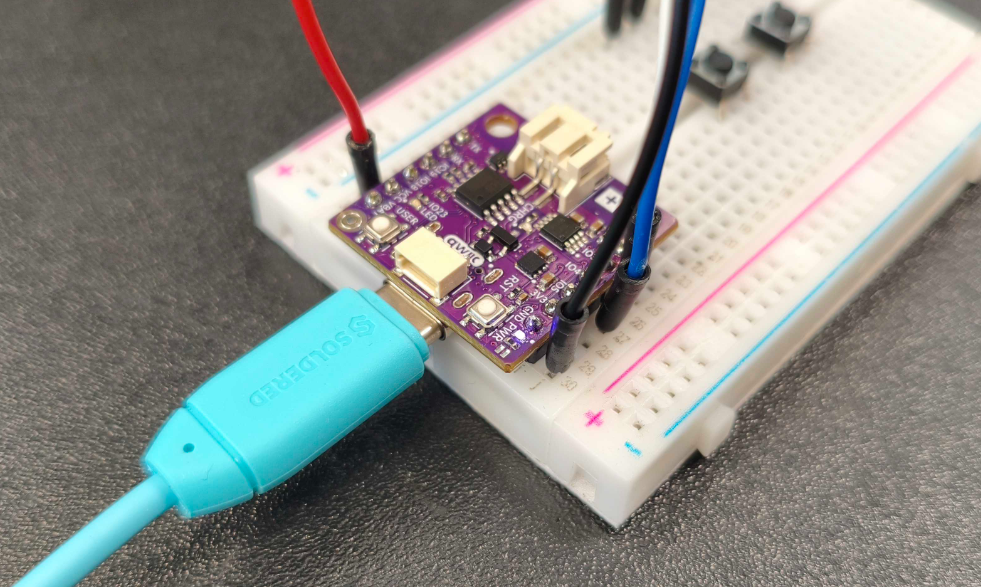
When using the NULA Mini ESP32-C6 on a breadboard, we recommend soldering male header pins so that the ESP32-C6 module (chip) faces downwards toward the breadboard.
This orientation keeps the board level and stable because the JST battery connector on the opposite side is taller and can prevent a flat fit on the breadboard.
This provides better mechanical stability and makes the USB-C port easier to access.
Qwiic / easyC Connector

Qwiic (formerly easyC) details and specifications
Learn more about Qwiic hardware compatibility and connector pinout.
Power Supply and Battery
- USB-C Port is used for both programming and powering the board
- VBAT (JST connector) is used for connecting a 3.7 V Li-Ion or Li-Poly battery
- The board includes an integrated Li-Ion charge management circuit
- Operating voltage: 3.3 V (onboard regulator for 5 V input)
For 5 V input, always power the board through the USB-C port.
Power Consumption
| Mode | Typical Current |
|---|---|
| Active (Wi-Fi TX) | around 120 mA |
| Modem-sleep | around 25 mA |
| Light-sleep | around 1 mA |
| Deep-sleep | around 7 µA |
Dimensions
- Board size: 25.33 × 25.33 x 10.0 mm (1.00 x 1.00 x 0.39 inch)
- Mounting: Breadboard compatible
- Header Pin Holes: 1.5 mm
- Screw Holes: Designed for M3 screws (3.2 mm diameter)
Soldered boards are LEGO compatible! 🧱
Jumper Details
This board includes two hardware jumpers that can be modified to adjust behavior or reduce power consumption.
| Jumper | Default State | Function |
|---|---|---|
| JP1 | NC (Normally closed) | Disconnects the Power LED to reduce standby current draw when running from battery power. |
| JP2 | NC (Normally closed) | Connects the 3.3 V I²C pull-up resistors for SDA and SCL lines when required by connected I²C devices. |
Use JP2 when connecting I²C sensors or peripherals that do not include onboard pull-up resistors.
Hardware repository
Schematics, KiCad files, Gerber files and more can be found in the GitHub repository:
The hardware repository contains everything you need to understand, modify, or manufacture the board. The different output folders are versioned. You can check which board version you have specifically by finding the version mark on the PCB.
Below is an overview of the available files.
CAD files
We use KiCad, an open-source PCB design tool. You can open and edit the .kicad_pro project file, which includes both the schematic and PCB layout.
The PANEL files are used internally for production.
Schematic
The OUTPUTS folder contains the schematic in .pdf format, exported from KiCad.
BOM (Bill of Materials)
The bill of materials (BOM) is provided in two formats:
- A standard
.csvtable, listing all components, part numbers, and values. - An interactive BOM (
.html) that visually highlights each component on the PCB, making it easy to locate and reference parts.
3D files
A 3D model of the PCB is available in .step format, allowing you to inspect the board design in CAD software.
Gerber files
Gerber files are essential for PCB manufacturing, as they contain precise instructions for each layer of the board. The repository includes standard Gerber outputs in a .zip file, such as:
- Copper layers (
.Cu.gbr) – Defines the traces and pads on the board. - Solder mask layers (
.Mask.gbr) – Specifies the protective solder mask. - Silkscreen layers (
.Silkscreen.gbr) – Contains text and component markings. - Paste layers (
.Paste.gbr) – Used for stencil fabrication in SMD assembly. - Drill files (
.drl) – Provides drilling coordinates for vias and holes. - Board outline (
.Edge_Cuts.gbr) – Defines the shape of the PCB. - Gerber job file (
.gbrjob) – Describes the set of Gerber files used for production.
These files are ready for fabrication and can be used in PCB manufacturing.
Compliance
The Compliance section includes important regulatory and safety documentation for this product. These files ensure compliance with relevant industry standards and legal requirements.
- CE – Certification document confirming compliance with EU safety, health, and environmental requirements.
- UKCA – UKCA (UK Conformity Assessed) certification for the UK market.
- Safety Instructions – Safety guidelines and precautions in English and in German.
- Info.txt – Contains product details such as SKU, country of origin, HS tariff code, and barcode.