WS2812B – How it works
The WS2812B is a smart RGB LED that features an integrated driver, meaning that each LED in the strip is individually addressable. The integrated driver enables the precise control of brightness and color for each LED via PWM (Pulse Width Modulation).
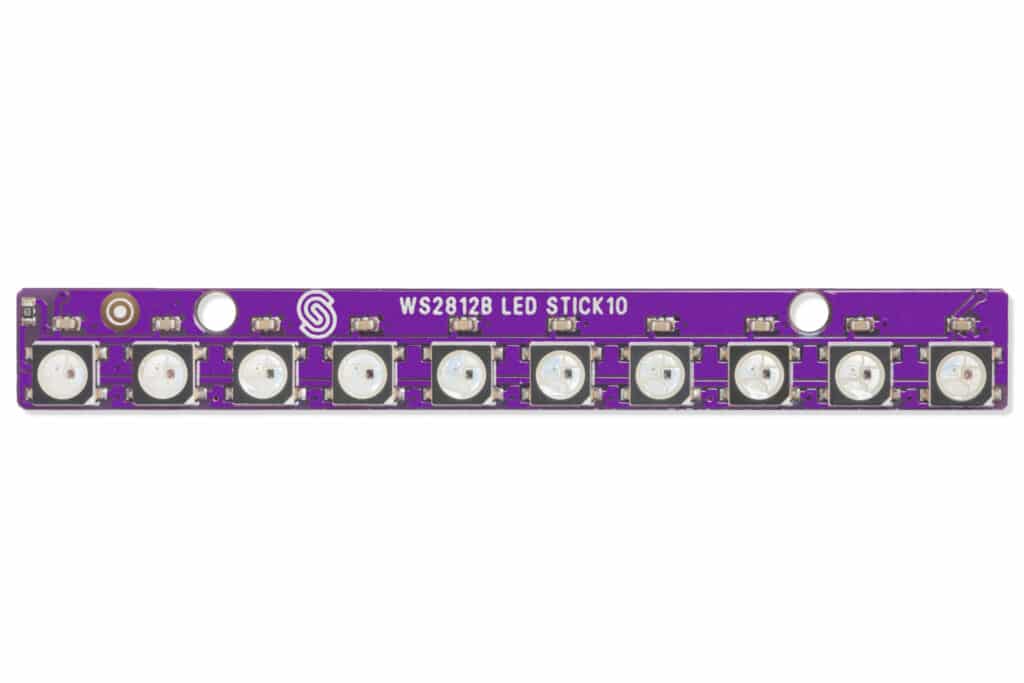
How the LED works
The WS2812B LED is designed for individually addressable lighting. Each LED contains an integrated driver, which allows for control of color and brightness from a single data line. Here’s how it works:
-
Data Input: The DIN (Data Input) pin receives a signal from a microcontroller that encodes the color information for the LEDs. The data is sent serially, one bit at a time, allowing for precise control of each LED in the chain.
-
Data Transmission: The DOUT (Data Output) pin passes the data on to the next LED in the chain, allowing you to control multiple LEDs using a single microcontroller. This makes the WS2812B ideal for large displays and decorative lighting.
-
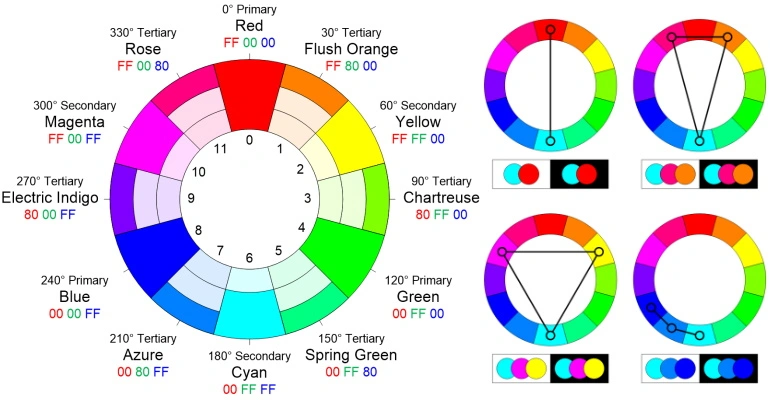
Color and Brightness Control: Each WS2812B LED contains red, green, and blue LED chips that can be independently controlled. The microcontroller sends pulse width modulation (PWM) signals to control the brightness of each color, allowing the creation of over 16 million colors.
-
PWM Control: The LED driver uses PWM to control the intensity of each individual color channel (Red, Green, Blue). By adjusting the duty cycle of the PWM signal, the brightness of each channel is varied, and, when combined, they produce different colors and effects.
-
Chaining: You can chain multiple WS2812B LEDs together in series, with each LED passing the data to the next. This allows the control of large LED strips or matrices using a single data line.
Data Transmission Protocol
The WS2812B uses a single-wire protocol for data transmission. It works by receiving a stream of data bits from the microcontroller, which represent the color and brightness for each LED. The protocol works in the following way:
- Each WS2812B LED requires a 24-bit data packet (8 bits for each color channel: Red, Green, Blue).
- The data is transmitted in serial format: 1-bit per clock cycle, with each color channel assigned 8 bits.
- The data signal is transmitted at a high speed to ensure smooth animations and effects, such as fades and color changes.
Communication Protocol
The WS2812B communicates through serial data transfer and does not require any complex protocols such as I2C or SPI. The data is simply sent in a sequence of bits, where each bit defines the brightness of the respective color channel for the LED.
- Single-wire data protocol for communication
- PWM control for individual LED brightness and color
- Chaining capability, allowing multiple LEDs to be controlled by a single data line
- Data transmission speed is fast enough to support real-time control for dynamic lighting effects.
The simplicity of the single-wire protocol makes the WS2812B LED strip a popular choice for LED displays, decorative lighting, and other DIY electronics projects.
Daisy Chain Configuration
The WS2812B LEDs are designed to be chained together in a daisy chain configuration. Each LED receives data through its DIN (Data Input) pin, processes its assigned color, and then forwards the remaining data to the next LED via DOUT (Data Output). This allows a single microcontroller to control an entire strip or matrix of LEDs using just one data line.
To set up a daisy chain:
- Connect the DOUT of the first LED to the DIN of the next LED.
- Repeat this connection for all LEDs in the strip.
- Ensure all LEDs share a common VCC (Power) and GND (Ground).
This configuration enables the creation of dynamic lighting effects across large LED installations with minimal wiring.