Voice to WAV
Record microphone audio to a WAV file
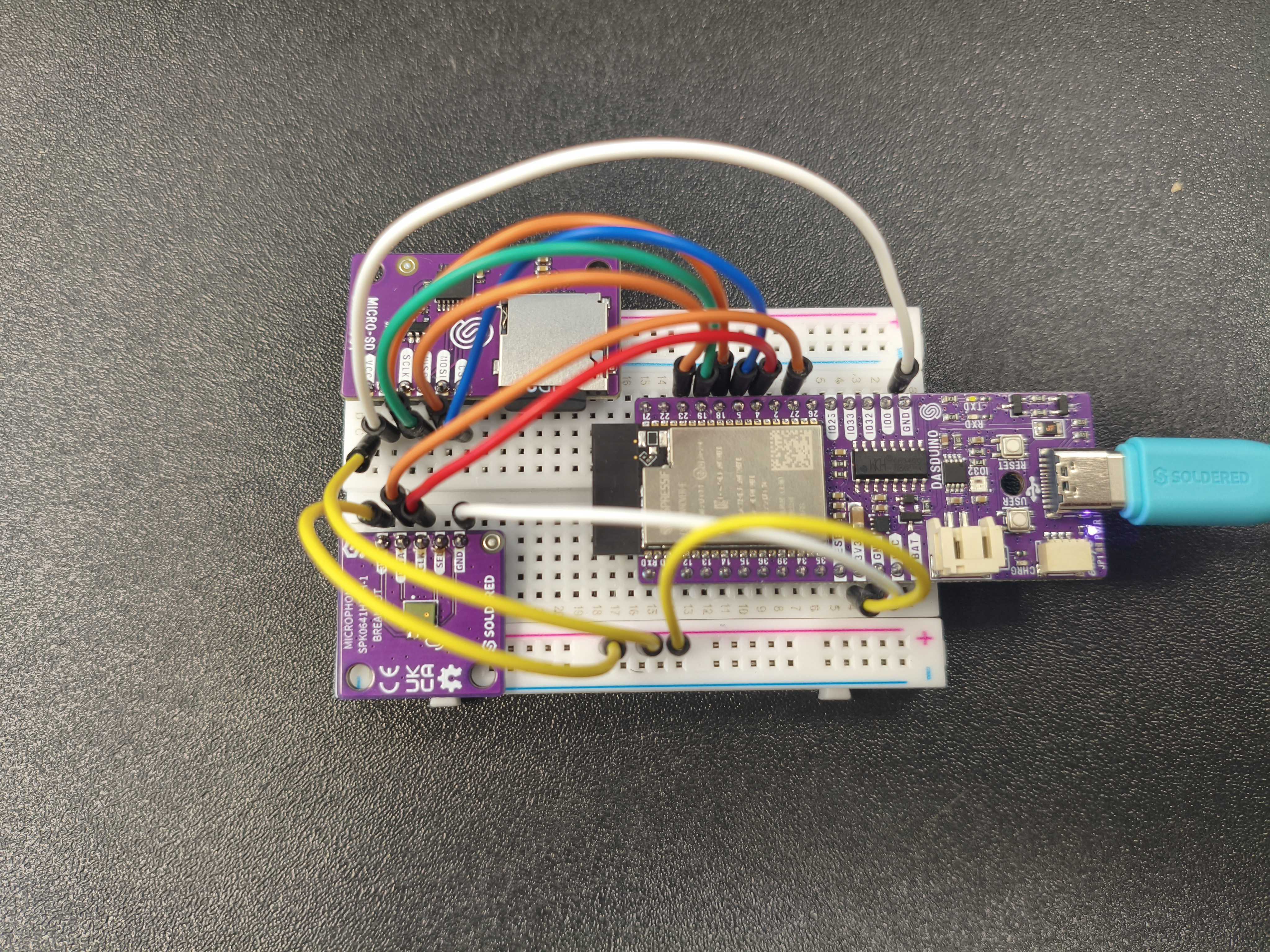
This example demonstrates how to set up the SPK0641HT4H-1 microphone with an ESP32, capture audio through its PDM interface, and store it as a WAV file on the SD card, ready to be transferred and played on a computer or phone.
#include <Arduino.h>
#include "Soldered-Microphone-SPK0641HT.h"
#include "SdFat.h"

constexpr int PDM_CLK = 4;
constexpr int PDM_DIN = 27;
constexpr int SD_CS   = 5;

#if HAS_SDIO_CLASS
  #define SD_CONFIG SdioConfig(FIFO_SDIO)
#elif ENABLE_DEDICATED_SPI
  #define SD_CONFIG SdSpiConfig(SD_CS, DEDICATED_SPI, SD_SCK_MHZ(16))
#else
  #define SD_CONFIG SdSpiConfig(SD_CS, SHARED_SPI, SD_SCK_MHZ(16))
#endif

SdFs sd;
FsFile wavFile;
Microphone mic;

const int sampleRate = 32000;
const int numChannels = 1;
const int bitDepth = 16;
const int numSamples = 512;

struct WavHeader {
  char riff[4] = {'R','I','F','F'};
  uint32_t chunkSize = 36;
  char wave[4] = {'W','A','V','E'};
  char fmt[4]  = {'f','m','t',' '};
  uint32_t fmtChunkSize = 16;
  uint16_t audioFormat = 1;
  uint16_t numChannels = 1;
  uint32_t sampleRate  = 32000;
  uint32_t byteRate    = 128000;
  uint16_t blockAlign  = 4;
  uint16_t bitsPerSample = 32;
  char data[4] = {'d','a','t','a'};
  uint32_t dataChunkSize = 0;
};
WavHeader wavHeader;

enum RecState { IDLE, RECORDING, STOPPING };
RecState recState = IDLE;
bool hasSDCard = false;
unsigned long recordingStartTime = 0;
const unsigned long maxRecordingTime = 30000;
char currentFilename[15] = "";

void updateWavHeader() {
  wavHeader.sampleRate    = sampleRate;
  wavHeader.numChannels   = numChannels;
  wavHeader.bitsPerSample = bitDepth;
  wavHeader.byteRate      = sampleRate * numChannels * (bitDepth / 8);
  wavHeader.blockAlign    = numChannels * (bitDepth / 8);
}

bool writeWavHeader() {
  if (!wavFile.isOpen()) return false;
  updateWavHeader();
  if (!wavFile.seek(0)) return false;
  size_t bytesWritten = wavFile.write((uint8_t*)&wavHeader, sizeof(WavHeader));
  return bytesWritten == sizeof(WavHeader);
}

bool startRecording() {
  if (!hasSDCard) {
    Serial.println("No SD card detected!");
    return false;
  }

  int fileIndex = 0;
  char filename[15];
  do {
    snprintf(filename, sizeof(filename), "REC%03d.WAV", fileIndex++);
  } while (sd.exists(filename) && fileIndex < 1000);

  if (!wavFile.open(filename, O_RDWR | O_CREAT | O_TRUNC)) {
    Serial.println("File create failed");
    return false;
  }

  strncpy(currentFilename, filename, sizeof(currentFilename));
  wavHeader.dataChunkSize = 0;
  wavHeader.chunkSize = 36;

  if (!writeWavHeader()) {
    wavFile.close();
    return false;
  }

  recState = RECORDING;
  recordingStartTime = millis();
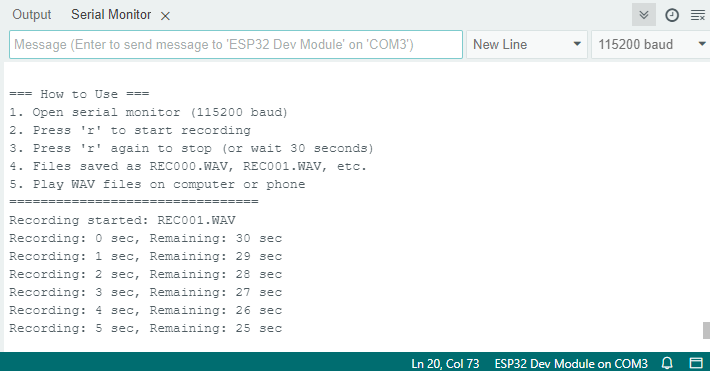
  Serial.printf("Recording: %s\n", filename);
  return true;
}

void stopRecording() {
  if (recState != RECORDING) return;
  recState = STOPPING;
  Serial.println("Stopping…");
}

void completeRecording() {
  if (!wavFile.isOpen()) return;
  uint32_t fileSize = wavFile.position();
  wavHeader.dataChunkSize = fileSize - sizeof(WavHeader);
  wavHeader.chunkSize = wavHeader.dataChunkSize + 36;

  if (!writeWavHeader()) Serial.println("Header update failed");
  wavFile.close();
  Serial.printf("Saved: %s (%lu bytes)\n", currentFilename, fileSize);
  recState = IDLE;
}

void setup() {
  Serial.begin(115200);
  delay(1000);

  Serial.println("ESP32 Microphone WAV Recorder");

  if (!sd.cardBegin(SD_CONFIG)) {
    Serial.println("SD init failed");
    hasSDCard = false;
  } else if (!sd.volumeBegin()) {
    Serial.println("FS init failed (format FAT32)");
    hasSDCard = false;
  } else {
    hasSDCard = true;
    Serial.println("SD ready");
  }

  Serial.println("Init microphone…");
  mic.begin(PDM_DIN, PDM_CLK, sampleRate, 16, 512);
  mic.setHPF(true);
  mic.setGainDb(10.0f);
  Serial.println("Mic ready");

  updateWavHeader();

  Serial.println("Press 'r' to start/stop (30s limit).");
}

void loop() {
  if (Serial.available()) {
    char command = Serial.read();
    if (command == 'r' || command == 'R') {
      if (recState == IDLE) startRecording();
      else if (recState == RECORDING) stopRecording();
    }
  }

  if (recState == RECORDING) {
    int16_t samples[numSamples];
    size_t count = mic.read(samples, numSamples);
    if (count > 0) {
      size_t bytesWritten = wavFile.write((uint8_t*)samples, count * sizeof(int16_t));
      if (bytesWritten != count * sizeof(int16_t)) {
        Serial.println("Write error");
        stopRecording();
      }
    }
    if (millis() - recordingStartTime >= maxRecordingTime) {
      Serial.println("30s limit reached");
      stopRecording();
    }
  } else if (recState == STOPPING) {
    completeRecording();
  }

  static unsigned long lastStatus = 0;
  if (millis() - lastStatus > 1000) {
    lastStatus = millis();
    if (recState == RECORDING) {
      unsigned long elapsed = (millis() - recordingStartTime) / 1000;
      unsigned long remaining = (maxRecordingTime / 1000) - elapsed;
      Serial.printf("Recording: %lus, Remaining: %lus\n", elapsed, remaining);
    }
  }
  delay(10);
}
Function reference
mic.begin(int pinData, int pinClk, uint32_t sampleRate, uint16_t bitDepth, size_t samplesPerBuffer)
Initializes the microphone driver and PDM capture. Host provides CLK; DATA is sampled and decimated to PCM with the chosen bit depth.
Returns value: bool, true on success
mic.setHPF(bool enabled)
Enables a high-pass filter to reduce DC offset and very low-frequency rumble.
Returns value: None
mic.setGainDb(float gainDb)
Applies digital gain (in dB) after decimation. Use modest values to avoid clipping.
Returns value: None
mic.read(int16_t* dst, size_t samples)
Fetches up to 'samples' PCM16 values from the PDM capture pipeline. Non-blocking; returns the number of samples actually read.
Returns value: int, number of samples read
startWav(File& f, uint32_t sampleRate, uint16_t bitDepth, uint16_t channels)
Writes a provisional 44-byte WAV header to an empty file. The data chunk size is patched later in finishWav().
Returns value: None
finishWav(File& f)
Seeks back into the header and patches RIFF/data chunk sizes so the file is valid.
Returns value: None
Full example
voiceToWAV_ESP32.ino
Record microphone audio to WAV on ESP32
Other supported boards
There is also an RP2350 version of this example with the same functionality, but adapted for RP2350 pinout and LittleFS:
voiceToWAV_RP2350.ino
Record microphone audio to WAV on RP2350 boards