Apds-9960 – How it works
APDS-9960 is a digital sensor that integrates RGB, ambient light, proximity, and gesture sensing in a single 8-pin package, manufactured by Broadcom.
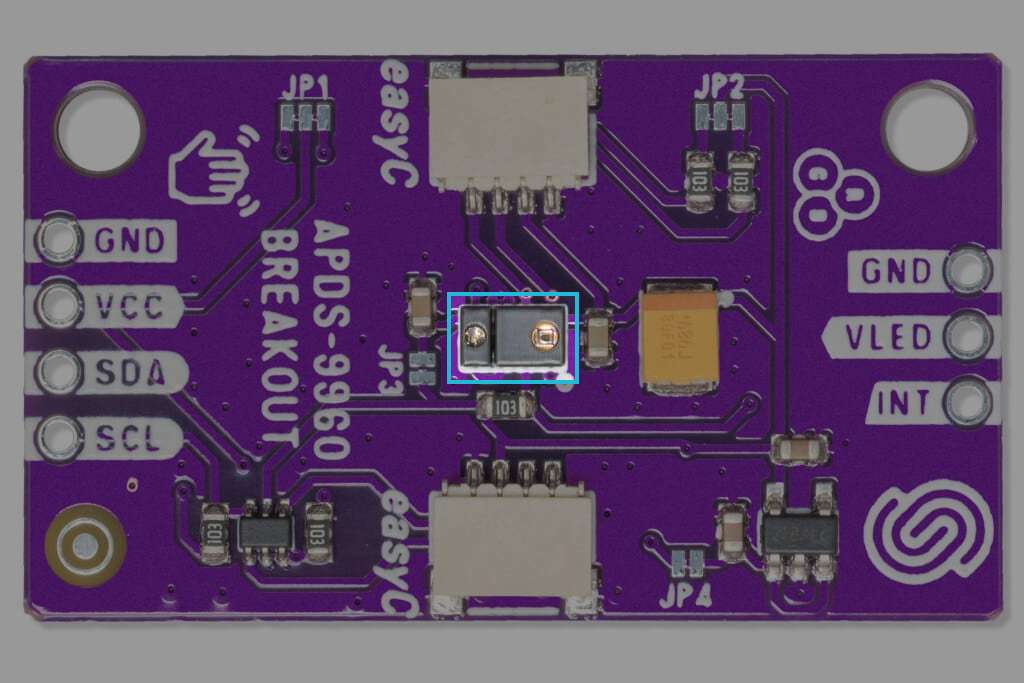
Datasheet
For an in-depth look at technical specifications, refer to the official APDS-9960 Datasheet:
APDS-9960 Datasheet
Detailed technical documentation for the APDS-9960 sensor
How the sensor works
The APDS-9960 is a versatile sensor that detects ambient light, proximity, and gestures. It integrates a photodiode, infrared LED, and analog-to-digital converters (ADC) into a compact module, offering efficient sensing in various applications.
The APDS-9960 operates efficiently with low power consumption and stable performance, making it ideal for touchless control and smart lighting applications.
-
Gesture Recognition - Gesture detection utilizes four directional photodiodes to sense reflected IR energy, converting physical motion information into digital data. The gesture engine accommodates a wide range of gestures, including up, down, left, right, and swipe movements.
-
Proximity Sensing - Using a photodiode, the sensor detects reflected IR energy to measure the distance to nearby objects, enabling proximity detection.
-
Ambient Light Sensing - The sensor uses a photodiode to measure ambient light, converting it into a digital signal via an onboard ADC (analog-to-digital converter), providing precise lux measurements.
-
Signal Processing and Output - The sensor processes the data internally, ensuring accurate and stable readings. The results are transmitted via an I2C interface for easy integration with microcontrollers.
I2C Communication
The APDS-9960 sensor uses I2C (Inter-Integrated Circuit) communication to exchange data with a microcontroller. I2C uses two lines: SDA for data transfer and SCL for clock synchronization.
As a follower device (a device that accepts or provides a digital message carrying measurement or other data, but only when specifically requested), the APDS-9960 has a unique address that allows a master device to send commands and receive data, enabling features like gesture recognition, proximity sensing, and ambient light measurements.