Ssd1306 – How it works
On this page, we will explain how an OLED display actually functions.
Overview
OLEDs are organic LEDs, which means that their key building blocks are organic (i.e., carbon-based) materials. Unlike LEDs, which are point light sources, OLEDs are manufactured as sheets that act as diffuse-area light sources. OLED technology is developing rapidly, and there are a handful of product offerings with efficacy, lifetime, and color quality specifications comparable to their LED counterparts. However, OLEDs are still several years away from widespread use as a source of general illumination, largely due to their high cost.
Datasheet
For an in-depth look at technical specifications, refer to the official SSD1306 Datasheet:
SSD1306 Datasheet
Detailed technical documentation for the SSD1306 display
Structure
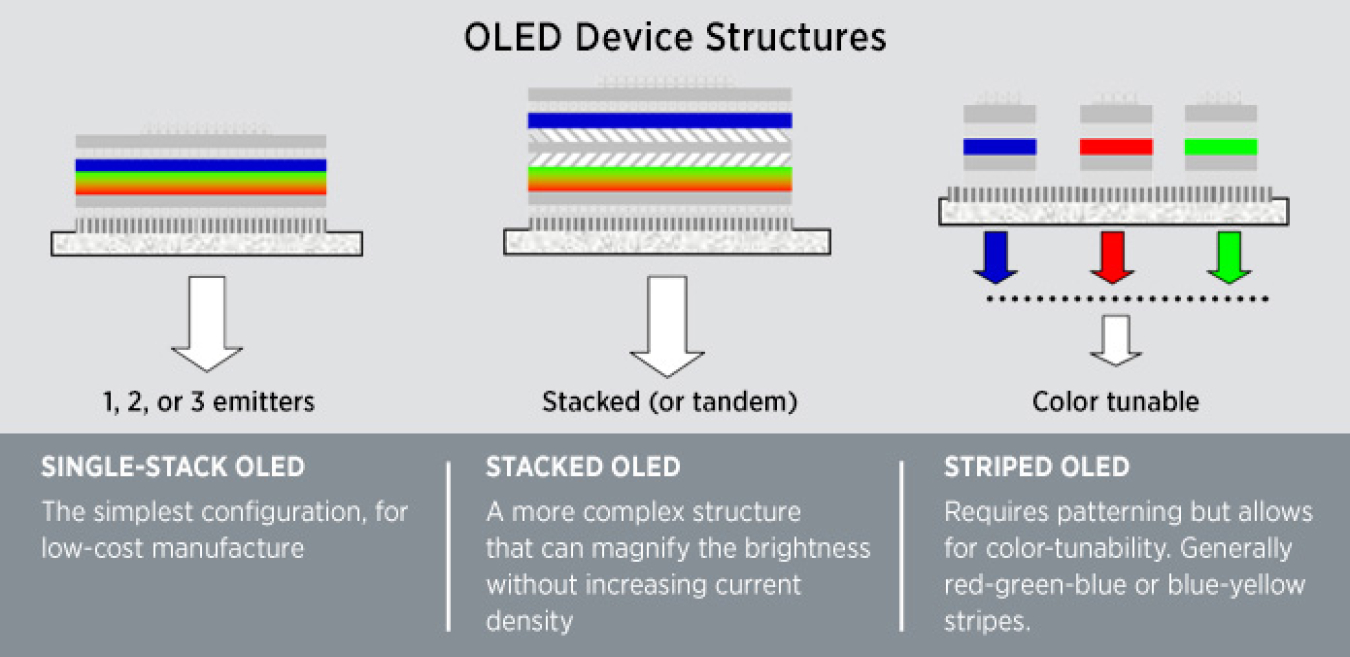
An OLED is a solid-state device consisting of a thin, carbon-based semiconductor layer that emits light when electricity is applied by adjacent electrodes. In order for light to escape from the device, at least one of the electrodes must be transparent. The intensity of the light emitted is controlled by the amount of electric current applied by the electrodes, and the light's color is determined by the type of emissive material used. To create white light, most devices use red, green, and blue emitters that can be arranged in several configurations.
SSD1306
SSD1306 is a single-chip CMOS OLED/PLED driver with a controller for an organic/polymer light-emitting diode dot-matrix graphic display system. It consists of 128 segments and 64 commons.
The SSD1306 displays data directly from its internal 128 x 64-bit Graphic Display Data RAM (GDDRAM). Data/commands are sent from a general MCU through the hardware-selectable I2C Interface.
I2C communication
The SSD1306 uses the I2C protocol to communicate with a microcontroller. It operates with an I2C address of 0x3C (it can also operate with an address of 0x3D when shorting the JP6 jumper—see the jumper details here).