BME688 Environmental Sensor - How it works
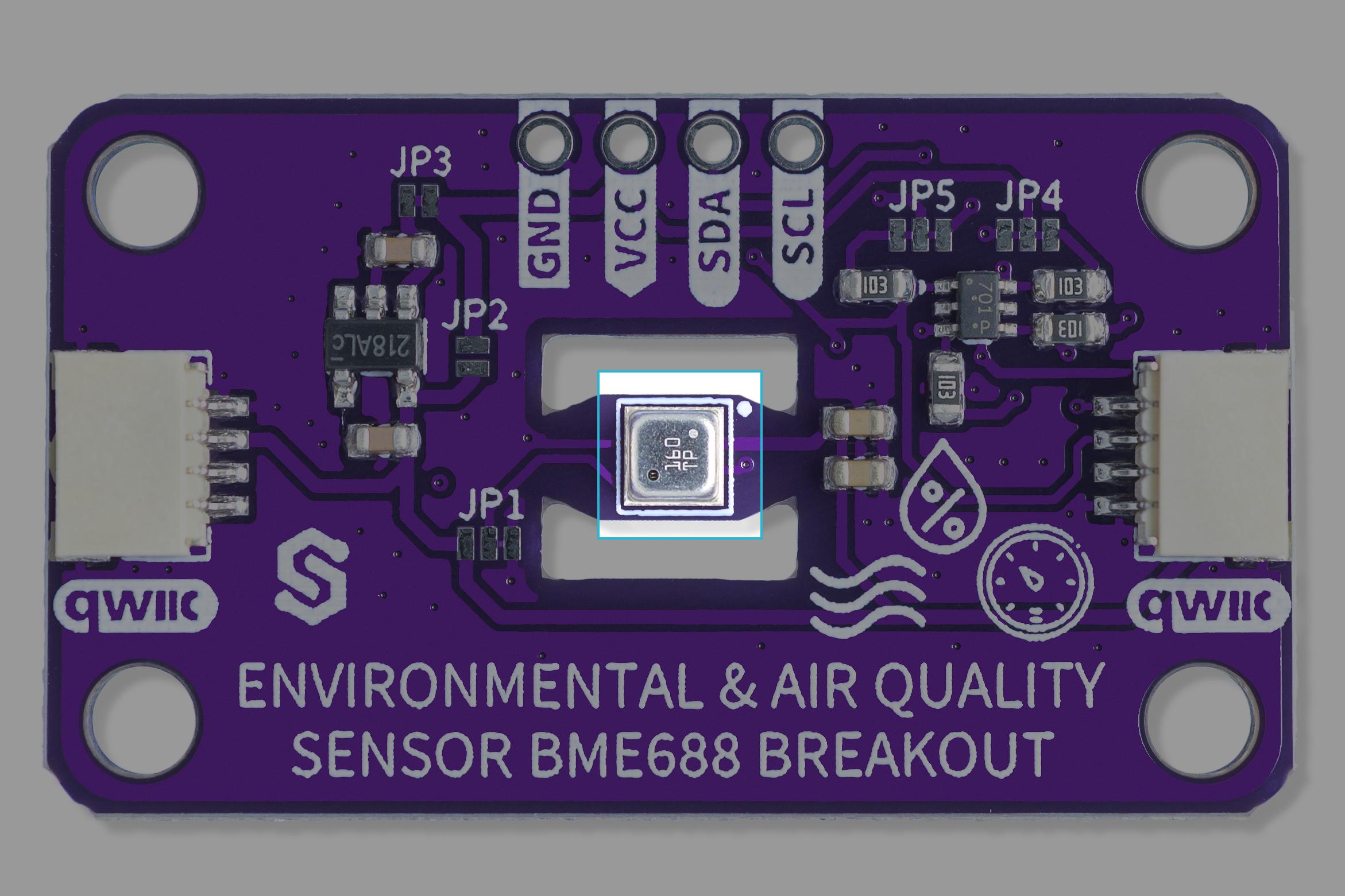
BME688 is an integrated circuit by Bosch. When using our board, you are essentially communicationg with the onboard BME688 directly via I2C communication.
Datasheet
For an in-depth look at technical specifications, refer to the official BME688 Datasheet
BME688 Datasheet
Detailed technical documentation for the BME688 sensor
How the sensor works
The Bosch BME688 is a compact enviromental sensor that combines gas, pressure, temperature and humidity sensing in one device. Its gas sensor uses a heated metal-oxide layer that changes electrical resistance when exposed to volatile organic compounds (VOCs) and other gases. By cycling the heater through different temperature steps, the sensor creates a "fingerprint" of gas responses, which allows it to distinguish between different gas mixtures. The raw resistance values are processed by Bosch's BSEC software, which applies compensation for humidity and temperature effects, then converts them into meaningful outputs such as an Index of Air Quality (IAQ), estimated CO2 levels, and breath-VOC equivalents. The BME688 continuously calibrates itself to typical indoor environments and can be customized with AI-based tools to recognize specific gas patterns for applications like air quality monitoring, food spoilage detection, or smart home devices.
I2C communication
The BME688 breakout board uses the I2C protocol to communicate with the microcontroller. It operates with a default I2C addres of 0x76 (or 0x77 if the SDO pin is pulled high). Upon request, the sensor responds with pressure and tepmerature values in a 20-bit format and the humidity value as a 16-bit ADC value, but you can use our library to interface with it in more detail.