How it works
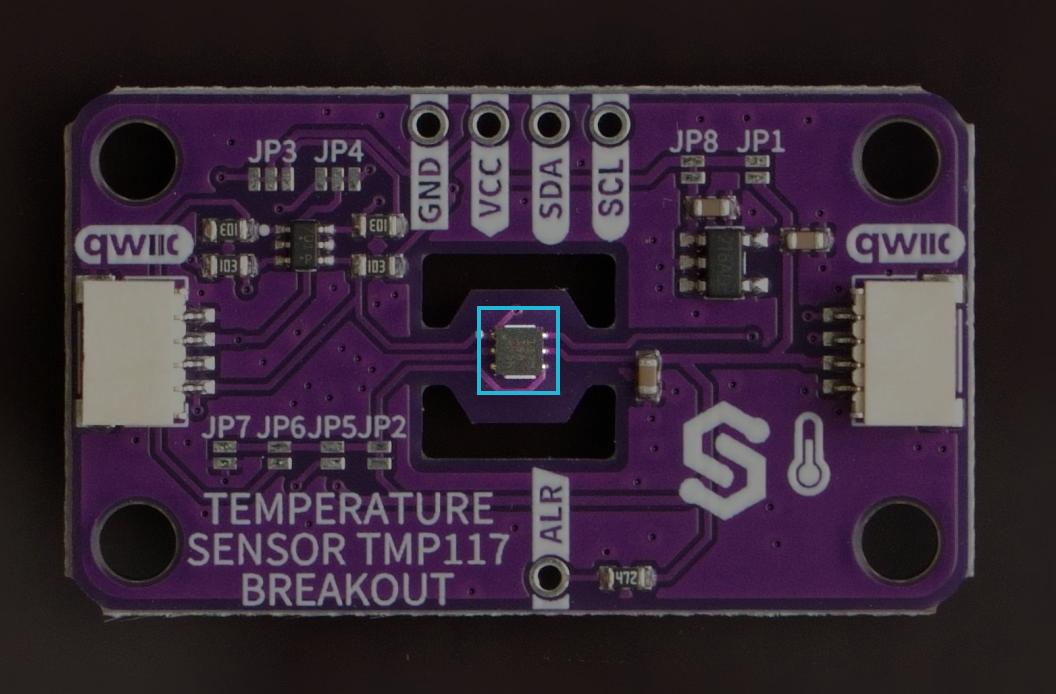
The TMP117 is a high-accuracy, low-power digital temperature sensor with an SMBus™- and I²C-compatible interface, designed and manufactured by Texas Instruments. It provides extremely precise temperature measurements across a wide range from –55 °C to +150 °C, making it ideal for applications where both precision and efficiency are required.
Datasheet
For an in-depth look at technical specifications, refer to the official TMP117 datasheet:
TMP117 Datasheet
Detailed technical documentation for the TMP117 high-accuracy digital temperature sensor
How the sensor works
The TMP117 combines a temperature-sensing element, 16-bit analog-to-digital converter (ADC), and digital logic into a single, factory-calibrated IC. This integration eliminates the need for analog front-end circuitry and external calibration, offering a simple digital interface for accurate temperature data acquisition.
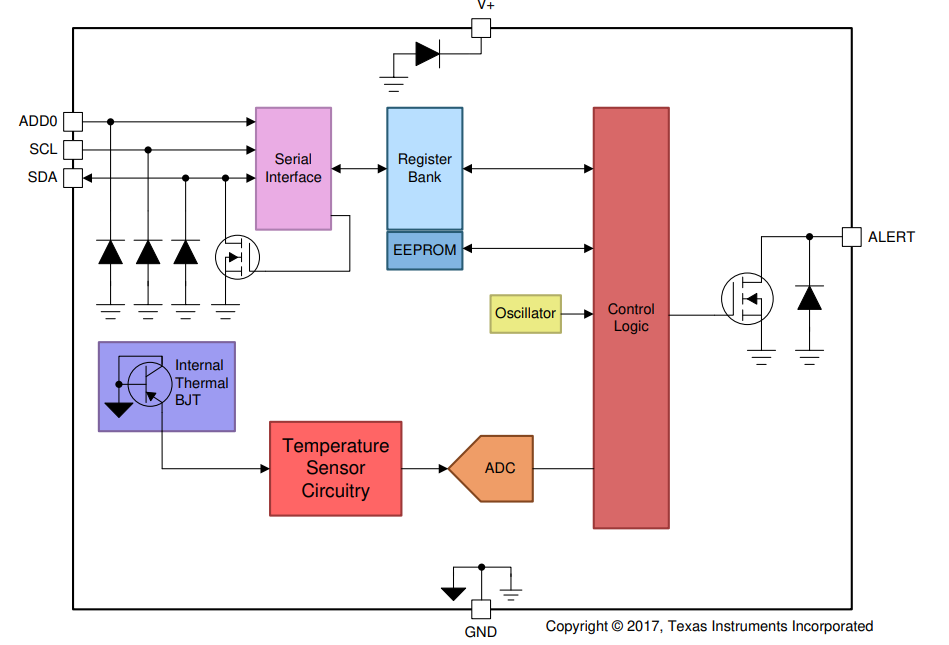
Each TMP117 device is calibrated against NIST-traceable temperature standards, achieving a typical accuracy of ±0.1 °C between –20 °C and +50 °C. The sensor measures temperature using a precision bandgap reference, and the internal 16-bit ADC converts this analog signal into a digital output with a resolution of 0.0078 °C per least significant bit (LSB). Because of this high resolution and stability, the TMP117 performs comparably to platinum resistance thermometers (such as PT100 or PT1000) in precision applications.
The sensor supports multiple operating modes that allow users to optimize for power or performance. In continuous conversion mode, the TMP117 performs ongoing measurements for real-time monitoring. Shutdown mode minimizes current consumption to approximately 150 nA, while one-shot mode enables single conversions on demand, providing flexibility for battery-powered and low-duty-cycle systems.
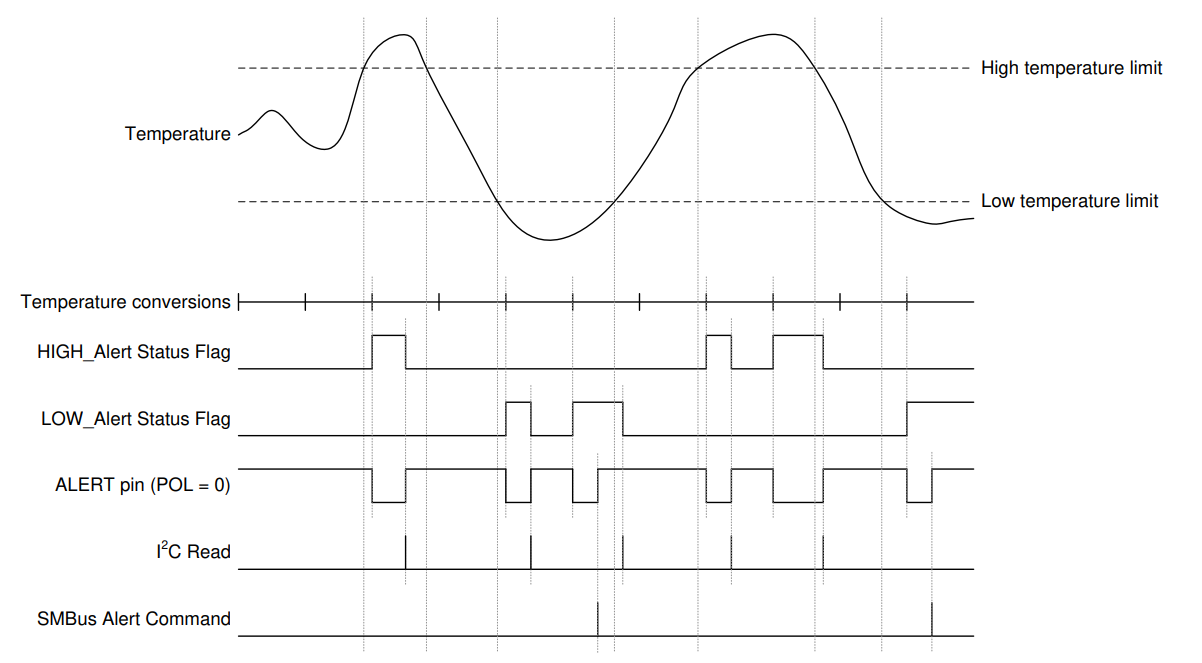
For temperature threshold monitoring, the device includes programmable high and low limit registers that trigger the ALERT pin when limits are exceeded. This output can be configured for different alert behaviors, such as comparator or therm mode, enabling both simple threshold warnings and window-based temperature detection.
The TMP117 also includes 48 bits of nonvolatile EEPROM memory, which can store calibration constants, device IDs, or system configuration data. The sensor’s design ensures exceptional long-term stability and minimal drift over time, making it suitable for industrial, medical, and scientific instrumentation.
I²C communication
Communication with the TMP117 occurs through a two-wire I²C interface consisting of the SDA (serial data) and SCL (serial clock) lines. Both lines require pull-up resistors, which are typically included on breakout boards. The sensor supports standard and fast-mode I²C operation, allowing easy integration with most microcontrollers.
The I²C address of the TMP117 is determined by the ADD0 pin, giving flexibility to connect up to four sensors on the same bus. Through this interface, the master device can read temperature data, configure conversion rates, set alert limits, and access the EEPROM memory.
During operation, temperature measurements are stored in a dedicated temperature register, which can be read as a 16-bit digital value. Configuration and status registers allow control over averaging, conversion timing, and alert functionality.
This combination of accuracy, simplicity, and low power makes the TMP117 an ideal choice for embedded systems, data logging, environmental monitoring, and medical-grade temperature measurement applications.