5W Stereo Audio Amplifier PAM8406 – How it works
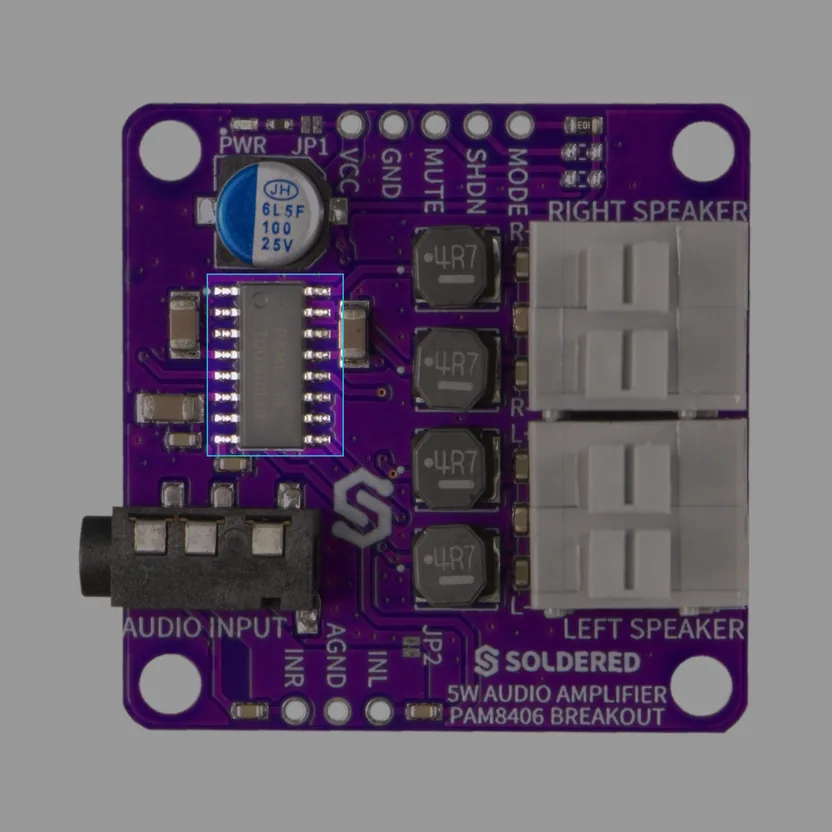
The PAM8406 is a Class-D stereo audio amplifier made by Diodes Incorporated. Instead of amplifying an analog waveform directly the way a Class-AB amplifier does, it converts the incoming audio signal into a high-frequency switching pattern and uses that to drive the speaker. This board wraps the PAM8406 with input coupling, an output filter, and a control header, so you can feed it line-level stereo audio and get amplified sound out the other side.
Datasheet
For the full electrical characteristics, absolute maximum ratings, and recommended application circuits, see the manufacturer datasheet:
PAM8406 Datasheet
Diodes Incorporated datasheet covering electrical characteristics, pin functions, and application circuits for the PAM8406.
How the amplifier works
The picture below shows the trick: the audio signal (green) is compared against a fast carrier wave (blue). Wherever the audio is above the carrier, the output pulses on; wherever it's below, the output pulses off. That's the pink PWM signal at the bottom, and its pulses get wider or narrower as the audio signal rises and falls.

The PAM8406 drives the speaker with that pulse train directly, switching fully on or fully off rather than sweeping through a continuous voltage range. Since the transistors spend almost no time in between, very little energy turns into heat, which is why Class-D amplifiers like this one are so efficient. A low-pass filter downstream (either inside the amplifier's switching scheme or added on the board) then smooths those pulses back into a clean audio waveform the speaker can reproduce. The PAM8406 is "filterless", meaning its switching scheme is clean enough to skip an external filter and drive a speaker directly, but this board adds a small LC filter per channel anyway to cut down EMI further.
The PAM8406 delivers 5W into a 2Ω load or 3.14W into 4Ω, both at 5V and 10% THD, and its efficiency depends on the load: around 80% into 2Ω, up to 90% into 8Ω. Short-circuit protection and a 150°C thermal shutdown (with 30°C of hysteresis) keep the chip safe if something goes wrong, and the MODE pin lets you fall back to Class-AB if Class-D's switching noise ever causes problems, at the cost of efficiency. This board's onboard pull-up on MODE defaults to Class-D.
Control pins
The PAM8406 doesn't use a data bus like I2C or SPI. Three digital pins on the K3 header control it directly: MODE picks Class-D or Class-AB, SHDN shuts the whole chip down when pulled low, and MUTE silences the output when pulled low. All three work with a plain digitalWrite(), no library needed. SHDN and MUTE both have internal pull-ups inside the PAM8406, so the amplifier runs normally even with nothing connected to them.