NEO-M9N-00B - How it works
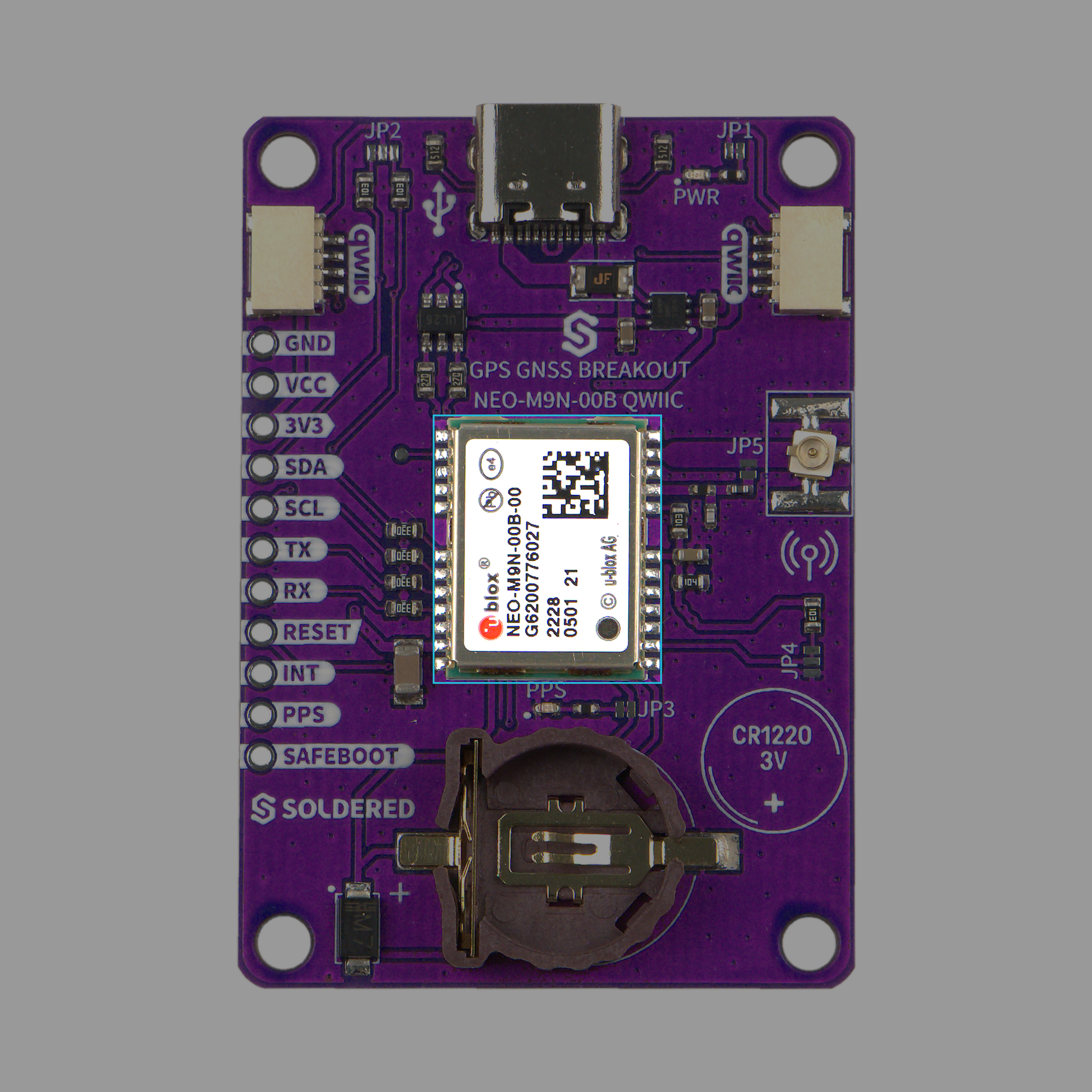
The NEO-M9N-00B is a GNSS module from u-blox that simultaneously receives signals from GPS, GLONASS, Galileo, and BeiDou constellations.
Datasheet
NEO-M9N-00B Datasheet
Detailed technical documentation for the NEO-M9N-00B GNSS module
How the module works
The NEO-M9N-00B integrates a GNSS receiver and signal processing unit that tracks signals from multiple satellite constellations at the same time.
-
Multi-constellation reception - The module simultaneously receives signals from GPS, GLONASS, Galileo, and BeiDou, which improves fix reliability and availability, especially in environments with obstructions.
-
Position fixing - Using signals from multiple satellites, the module calculates latitude, longitude, and altitude through trilateration, achieving a horizontal accuracy of up to 2.0 meters CEP.
-
Velocity and heading - Beyond position, the module computes speed and direction of movement.
-
Timepulse output - The module provides a configurable 1PPS signal synchronized to GNSS time, useful for precise timing applications.
-
Protocol output - Positioning results are delivered via UART, I2C, or SPI using the standard NMEA 0183 protocol or the proprietary UBX binary protocol.
-
Update rate - The module can output a new position up to 25 times per second, far more often than most GNSS receivers need, useful for tracking fast-moving objects.
-
Time to first fix - A cold start (first power-up, or after a long time unpowered) takes around 24-29 seconds depending on which constellations are enabled. A hot or aided start, with recent almanac data still available (for example from the CR1220 backup battery), takes around 2 seconds.
Each of the four constellations the module can track sits in its own set of medium-Earth orbits, all far higher up than something like the International Space Station:

Tracking more than one of these constellations at once means more visible satellites overall, which is what actually improves the fix, not any single constellation being "better" than another.
Once the module has locked onto enough satellites, it works out its position by trilateration: each satellite broadcasts its own orbital position along with a precise timestamp, and the receiver measures how long the signal took to arrive to work out its distance to that satellite. Doing this for several satellites at once narrows the possible location down to a single point on Earth, the intersection of all those distance measurements.

In practice the module needs at least 4 satellites for a full 3D fix (latitude, longitude, altitude), since it also has to solve for its own clock error alongside the three position coordinates. This is also why more satellites in view, thanks to tracking several constellations at once, means a faster and more reliable fix.
I2C & UART Communication
The NEO-M9N-00B supports both I2C and UART communication at the same time, which is the module's default configuration.
-
I2C uses two lines: SDA for data and SCL for clock, with a default address of 0x42. Multiple I2C devices can share the same bus. The module only supports I2C Fast-mode (400 kbit/s), it doesn't fall back to Standard-mode (100 kbit/s), and it can use clock stretching (holding SCL low for up to 20 ms) to pause a transaction when it needs more time.
-
UART uses TX and RX lines for serial communication, useful when higher data throughput or simpler wiring is preferred.
SPI communication
The same four pins used for I2C and UART (SDA, SCL, TX, RX) double as an SPI interface: SPI_CS_N, SPI_SCK, SPI_MISO, and SPI_MOSI respectively. Which function they serve depends on the D_SEL pin, broken out on this board as the JP4 selectable jumper:
- JP4 default position - D_SEL is pulled high, so the module runs in I2C + UART mode and the SPI functions are inactive.
- JP4 re-bridged to the other position - D_SEL is pulled to ground, so the module switches to SPI-only mode. I2C is disabled entirely while SPI is active.
The module only exposes one interface pair at a time on these shared pins, so you need to decide upfront which one you'll use and set the jumper accordingly. SPI runs in mode 1 (CPHA = 0) at up to 5.5 MHz, with a maximum transfer rate of 125 kB/s, which is slower than what the interface itself can theoretically reach but still fast enough for GNSS data.
Additional capabilities
Beyond basic positioning, the NEO-M9N supports a couple of features worth knowing about:
-
SBAS augmentation - The module can use satellite-based augmentation systems (SBAS) like WAAS or EGNOS, regional networks of ground stations and geostationary satellites that broadcast correction data, to improve position accuracy further.
-
Jamming and interference monitoring - The receiver can detect RF jamming or interference on the GNSS frequency bands and report it, which is useful for diagnosing why a fix is suddenly unreliable in an otherwise clear-sky environment.
Both are configured through UBX messages rather than dedicated pins, so they don't require any extra wiring, only the corresponding library or u-center commands to enable.