PCAL6416A - Interrupts
This page covers using the PCAL6416A's interrupt output to detect pin changes without polling every pin over I2C.
Interrupts
The PCAL6416A's INT pin pulls low whenever an enabled input pin changes state. Instead of continuously reading every pin over I2C, connect INT to a microcontroller pin and let it tell you when something changed.
Connect a pushbutton between A0 and GND, and another between A1 and GND. Connect the PCAL6416A's INT pin to pin IO4 on your development board.
#include "PCAL6416A-SOLDERED.h"

PCAL6416A expander;

#define INT_PIN 4

bool intFlag = 0;

void myISR()
{
    intFlag = 1;
}

void setup()
{
    Serial.begin(115200);

    expander.begin();

    expander.pinModePCAL(PCAL6416A_A0, INPUT_PULLUP);
    expander.pinModePCAL(PCAL6416A_A1, INPUT_PULLUP);

    pinMode(INT_PIN, INPUT_PULLUP);

    expander.setInterruptPCAL(PCAL6416A_A0, true);
    expander.setInterruptPCAL(PCAL6416A_A1, true);

    // Enabling interrupts above can immediately latch one against the pins'
    // power-on state, so clear it before arming the falling-edge interrupt -
    // otherwise INT can start out already low, with no edge left to catch.
    expander.getInterruptsPCAL();
    expander.digitalReadPCAL(PCAL6416A_A0);
    expander.digitalReadPCAL(PCAL6416A_A1);

    attachInterrupt(digitalPinToInterrupt(INT_PIN), myISR, FALLING);
}

void loop()
{
    if (intFlag)
    {
        intFlag = 0;
        uint16_t intReg = expander.getInterruptsPCAL();

        if (intReg & 1 << PCAL6416A_A0)
        {
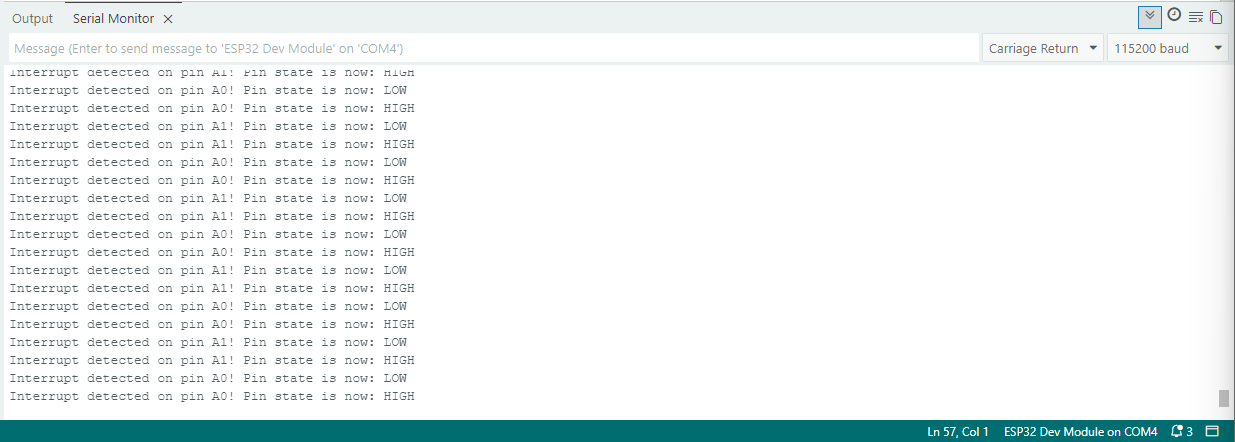
            Serial.print("Interrupt detected on pin A0! Pin state is now: ");
            expander.digitalReadPCAL(PCAL6416A_A0) ? Serial.println("HIGH") : Serial.println("LOW");
        }

        if (intReg & 1 << PCAL6416A_A1)
        {
            Serial.print("Interrupt detected on pin A1! Pin state is now: ");
            expander.digitalReadPCAL(PCAL6416A_A1) ? Serial.println("HIGH") : Serial.println("LOW");
        }
    }
}
expander.setInterruptPCAL()
Enables or disables the interrupt for a single GPIO pin on the PCAL6416A expander.
Returns value: None.
Function parameters:
| Type | Name | Description |
|---|---|---|
uint8_t | pin | The GPIO pin to configure. Use a constant such as PCAL6416A_A0-PCAL6416A_A7 or PCAL6416A_B0-PCAL6416A_B7. |
bool | enable | true to enable interrupts on this pin, false to disable. |
expander.getInterruptsPCAL()
Reads the interrupt status register, which pin triggered the last interrupt.
Returns value: uint16_t bitmask - bit N set means pin N (PCAL6416A_A0-A7 = bits 0-7, PCAL6416A_B0-B7 = bits 8-15) triggered an interrupt.
Open the Serial Monitor at 115200 baud and press either button. The callback (myISR) just sets a flag, since interrupt callbacks should stay as short as possible - the actual work of checking which pin changed happens in loop().
interrupts.ino
Full interrupts example for the PCAL6416A GPIO expander