SCD43 - How it works
The SCD43 is a CO2, temperature, and humidity sensor by Sensirion. It communicates with a microcontroller via I2C at a fixed address of 0x62.
Datasheet
SCD4x Datasheet
Technical documentation for the Sensirion SCD4x CO2 sensor family (version 1.7, April 2025)
How the CO2 sensor works
The SCD43 measures CO2 using photoacoustic NDIR (Non-Dispersive Infrared) sensing. An infrared light source inside the sensor emits modulated IR light through the sample gas. CO2 molecules absorb IR light at ~4.26 µm, causing them to heat up and expand in sync with the modulation - creating tiny pressure waves that a microphone inside the sensor picks up. The amplitude of these pressure waves corresponds directly to the CO2 concentration.
How the temperature and humidity sensor works
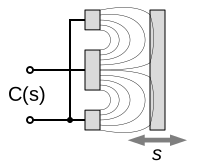
The SCD43 includes a capacitive humidity sensor: a polymer film between two electrodes absorbs or releases water molecules from the surrounding air, changing the capacitance between the plates. That change is converted into a relative humidity reading. Temperature is measured at the same time and used to compensate both the humidity and CO2 readings.
Automatic Self-Calibration (ASC)
The SCD43 has an Automatic Self-Calibration (ASC) algorithm that corrects long-term CO2 drift. It assumes the sensor is periodically exposed to fresh outdoor air and recalibrates against a target baseline, which defaults to 400 ppm and can be changed with setAutomaticSelfCalibrationTarget(). ASC is on by default and works well for most indoor installations. It can be turned off when the sensor is never exposed to fresh air - for example in sealed enclosures or industrial setups.
I2C communication
The SCD43 communicates over I2C with a fixed address of 0x62.
Two operating modes are available:
- Periodic measurement mode - The sensor takes measurements every 5 seconds and stores the latest result. The microcontroller reads CO2, temperature, and humidity with a single command.
- Single-shot mode - The sensor takes one measurement on demand, then idles. Useful for low-power applications.
Every I2C transaction follows the same pattern shown below: the host pulls SDA low while SCL is high to signal a start condition (S), then SCL toggles once per bit as data (the command being sent, or the measurement bytes coming back) shifts out one bit at a time over SDA, and the transaction ends with a stop condition (P), SDA going high while SCL is high. The Arduino library handles all of this internally: readMeasurement() runs this exact exchange, checks the CRC on each value, and hands you back the CO2, temperature, and humidity readings ready to use.

Each measurement returns three values: CO2 (ppm), temperature (°C), and relative humidity (%), packed into a single I2C transaction with CRC checksums.