Hardware Design
Inkplate 2 is an open-source, low-power development board based on an ESP32 microcontroller, with a 2.13-inch three-color (black, white and red) e-paper display. It has a small footprint and works with Arduino and MicroPython. This page covers the Inkplate 2’s hardware design: schematics, specs, and component layout.
ℹ️
All hardware design files are available in the Inkplate 2 GitHub repository and are covered by an open-source license.
Basic overview
Inkplate 2 is a compact, plug-and-play e-paper board with support for Wi-Fi and Bluetooth via the onboard ESP32. It features:
- A 2.13-inch three-color e-paper display (black, white, and red)
- ESP32 microcontroller for wireless connectivity
- USB-C for power and programming
- 4 MB flash memory
- Support for Arduino
- Ultra-low power usage: ~8µA in deep sleep mode
- CH340C USB to UART converter
- MCP73831 lithium-ion battery charger
- GPIO, I²C, and SPI breakouts
- Qwiic-compatible connector
- Optimized form factor for enclosure integration
ℹ️
Inkplate 2 works well for low-power, always-on displays such as clocks, tags, signs, and small IoT dashboards. It’s beginner-friendly, yet capable enough for advanced applications.
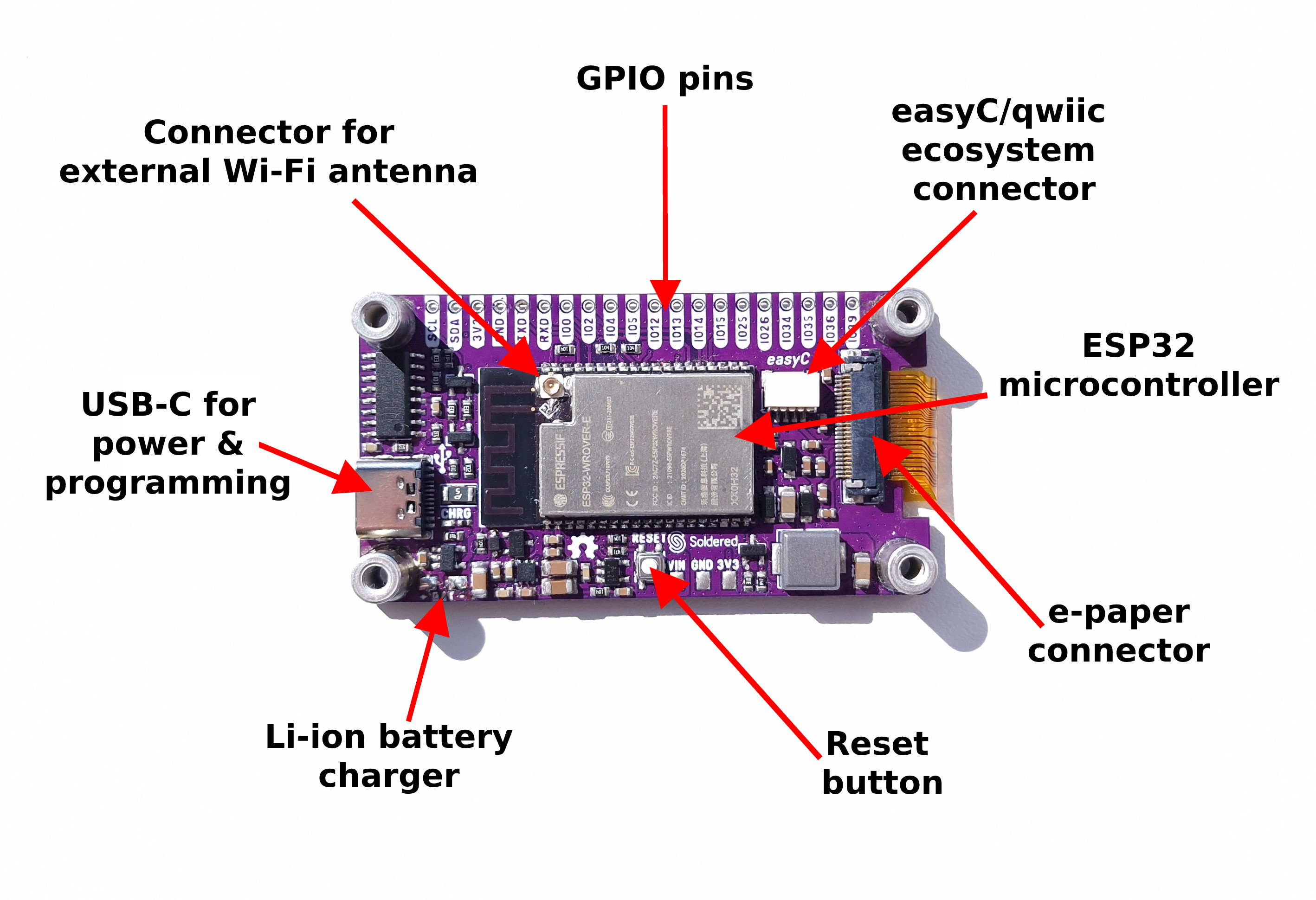
Inkplate 2, back side
E-paper panel: 2.13-inch three-color
The Inkplate 2 uses a 2.13″ three-color e-paper panel that can display black, white, and red. This kind of display stays clearly visible even in direct light and uses very little power.
| Specification | Details |
|---|---|
| Panel Size | 2.13 inches |
| Resolution | 212 × 104 pixels |
| Color | Black / White / Red |
| Display Technology | E Ink – Active Matrix EPD |
| Interface | SPI |
| Viewing Angle | Ultra-wide (nearly 180°) |
| Refresh Time | Varies per color mode (~15s with red) |
| Touchscreen | No |
| Backlight | No |
| Power Usage | ~8 µA in deep sleep |
| Supply Voltage | 3.3V |
| Operating Temperature | 0°C to 40°C |
| Storage Temperature | -25°C to 60°C |
ℹ️
The Inkplate 2’s display draws almost no power, since it only uses current when the screen updates.