NEO-M9N-00B - Debug Output
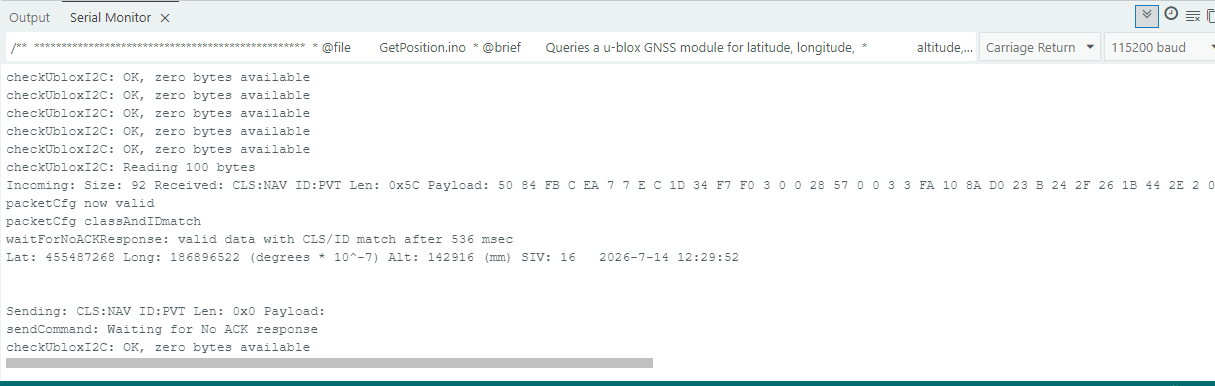
This page contains an example of enabling the library's debug output, which prints the raw UBX packets and internal status messages the library sends and receives. Use this to troubleshoot communication issues or see what's actually happening under the hood.
Initialization
Include the required libraries and create the module object:
#include <Wire.h>
#include <Soldered-GNSS.h>

Soldered_GNSS myGNSS;

unsigned long lastTime = 0;
int counter = 0;
In the setup() function, initialize the module and turn on debugging:
void setup()
{
    Serial.begin(115200);
    while (!Serial);
    Serial.println("Soldered u-blox GNSS Example - Debug Output");

    Wire.begin();

    if (myGNSS.begin() == false)
    {
        Serial.println(F("u-blox GNSS not detected at default I2C address. Please check wiring. Freezing."));
        while (1);
    }

    myGNSS.setI2COutput(COM_TYPE_UBX);

    myGNSS.enableDebugging(); // Print all debug messages to Serial
    // myGNSS.enableDebugging(Serial, true); // Or print only critical messages
}
myGNSS.begin()
Initializes the GNSS module and establishes I2C communication
Returns value: Boolean value, true if the module is detected and communication succeeds, false otherwise
myGNSS.enableDebugging()
Prints the library's internal debug messages (UBX packets sent/received, parsing status, errors) to a Serial port
Returns value: None
Function parameters:
| Type | Name | Description |
|---|---|---|
Stream & | debugPort | Optional. The Serial port to print debug messages to. Defaults to Serial |
bool | printLimitedDebug | Optional. When true, only critical messages are printed instead of everything. Defaults to false |
Taking measurements
In the loop() function, the module is polled once per second. Debug messages print alongside the readings, then automatically stop after 20 readings:
void loop()
{
    if (millis() - lastTime > 1000)
    {
        lastTime = millis();

        long latitude = myGNSS.getLatitude();
        Serial.print(F("Lat: "));
        Serial.print(latitude);

        long longitude = myGNSS.getLongitude();
        Serial.print(F(" Long: "));
        Serial.print(longitude);
        Serial.print(F(" (degrees * 10^-7)"));

        long altitude = myGNSS.getAltitude();
        Serial.print(F(" Alt: "));
        Serial.print(altitude);
        Serial.print(F(" (mm)"));

        byte SIV = myGNSS.getSIV();
        Serial.print(F(" SIV: "));
        Serial.println(SIV);

        counter++;
        if (counter == 20)
        {
            myGNSS.disableDebugging();
        }
    }
}
myGNSS.getLatitude()
Reads the current latitude from the GNSS module
Returns value: Long value, latitude in degrees multiplied by 10^-7
myGNSS.getLongitude()
Reads the current longitude from the GNSS module
Returns value: Long value, longitude in degrees multiplied by 10^-7
myGNSS.getAltitude()
Reads the current altitude from the GNSS module
Returns value: Long value, altitude in millimeters
myGNSS.getSIV()
Reads the number of satellites currently in view
Returns value: Byte value, number of satellites in view
myGNSS.disableDebugging()
Stops the library from printing debug messages
Returns value: None
Full example
You can find the full sketch below:
DebugOutput.ino
An example of enabling debug output while reading GPS position data with the NEO-M9N-00B module