SCD43 - Signal compensation
This page walks through the SignalCompensation example: adjusting the temperature offset, sensor altitude, and ambient pressure settings the SCD43 uses to correct its readings.
Temperature offset
Any nearby heat source, including the microcontroller itself, can make the SCD43 report a temperature slightly higher than the actual ambient air, which the troubleshooting page also notes under self-heating. The temperature offset setting corrects for this. As with any configuration change, the sensor needs to be in idle mode first:
#include "SCD43-SOLDERED.h"

SCD43 sensor;

void setup()
{
    Serial.begin(115200);
    Serial.println("SCD43 - Signal Compensation");

    Wire.begin();

    if (!sensor.begin())
    {
        Serial.println("Sensor not found. Check wiring. Halting.");
        while (1)
            ;
    }

    if (!sensor.stopPeriodicMeasurement())
    {
        Serial.println("Could not stop periodic measurement. Halting.");
        while (1)
            ;
    }

    Serial.print("Temperature offset before: ");
    Serial.print(sensor.getTemperatureOffset(), 2);
    Serial.println(" C");

    sensor.setTemperatureOffset(4.0f); // default is 4 C; adjust for your enclosure

    Serial.print("Temperature offset after:  ");
    Serial.print(sensor.getTemperatureOffset(), 2);
    Serial.println(" C");
sensor.getTemperatureOffset()
Returns the temperature compensation offset currently used by the sensor. Only available in idle mode.
Returns value: Temperature offset in degrees Celsius as a float.
sensor.setTemperatureOffset()
Sets the temperature compensation offset, correcting for self-heating from nearby components. The factory default is 4 degrees C. Only available in idle mode.
Returns value: Returns true on success, false otherwise.
Function parameters:
| Type | Name | Description |
|---|---|---|
float | offsetCelsius | Temperature offset in degrees Celsius, 0-20 C recommended |
Sensor altitude
CO2 measurements also depend on atmospheric pressure, which drops with elevation. If the sensor is installed somewhere well above sea level, telling it the altitude improves accuracy:
    Serial.print("Sensor altitude before: ");
    Serial.print(sensor.getSensorAltitude());
    Serial.println(" m");

    sensor.setSensorAltitude(150); // set to your installation altitude in metres

    Serial.print("Sensor altitude after:  ");
    Serial.print(sensor.getSensorAltitude());
    Serial.println(" m");
sensor.getSensorAltitude()
Returns the sensor altitude currently used for pressure compensation. Only available in idle mode.
Returns value: Altitude in meters above sea level as a uint16_t.
sensor.setSensorAltitude()
Sets the installation altitude used for pressure compensation. The factory default is 0 m. Only available in idle mode.
Returns value: Returns true on success, false otherwise.
Function parameters:
| Type | Name | Description |
|---|---|---|
uint16_t | altitudeMeters | Altitude in meters above sea level, 0-3000 m |
Ambient pressure
If a barometer is available, feeding the SCD43 a live pressure reading is more accurate than a fixed altitude, and overrides it:
    if (sensor.setAmbientPressure(101300)) // 101300 Pa = standard sea-level pressure
    {
        Serial.println("Ambient pressure set to 101300 Pa.");
    }
sensor.setAmbientPressure()
Sets the ambient pressure for continuous compensation, overriding altitude-based compensation. Can be called during periodic measurements for dynamic updates, unlike temperature offset and altitude. The factory default is 101300 Pa.
Returns value: Returns true on success, false otherwise.
Function parameters:
| Type | Name | Description |
|---|---|---|
uint32_t | pressurePa | Ambient pressure in Pascals, 70000-120000 Pa |
Unlike the temperature offset and altitude, ambient pressure isn't saved by persistSettings(). If you have a live barometer feeding this value, that's fine since you'd set it fresh on every boot anyway.
Saving the settings and finishing up
    if (sensor.persistSettings())
    {
        Serial.println("Temperature offset and altitude saved to EEPROM.");
    }

    uint64_t serialNumber = 0;
    if (sensor.getSerialNumber(serialNumber))
    {
        Serial.print("Sensor serial number: 0x");
        Serial.println((uint32_t)(serialNumber >> 16), HEX);
        Serial.println((uint32_t)(serialNumber & 0xFFFF), HEX);
    }

    if (!sensor.startPeriodicMeasurement())
    {
        Serial.println("Could not restart periodic measurement. Halting.");
        while (1)
            ;
    }

    Serial.println("Periodic measurements restarted.");
}
sensor.getSerialNumber()
Reads the sensor's unique 48-bit serial number. Only available in idle mode.
Returns value: Returns true on success, false otherwise. The serial number is written to the output parameter.
Function parameters:
| Type | Name | Description |
|---|---|---|
uint64_t& | serialNumber | Output: receives the 48-bit serial number |
Confirming readings still work
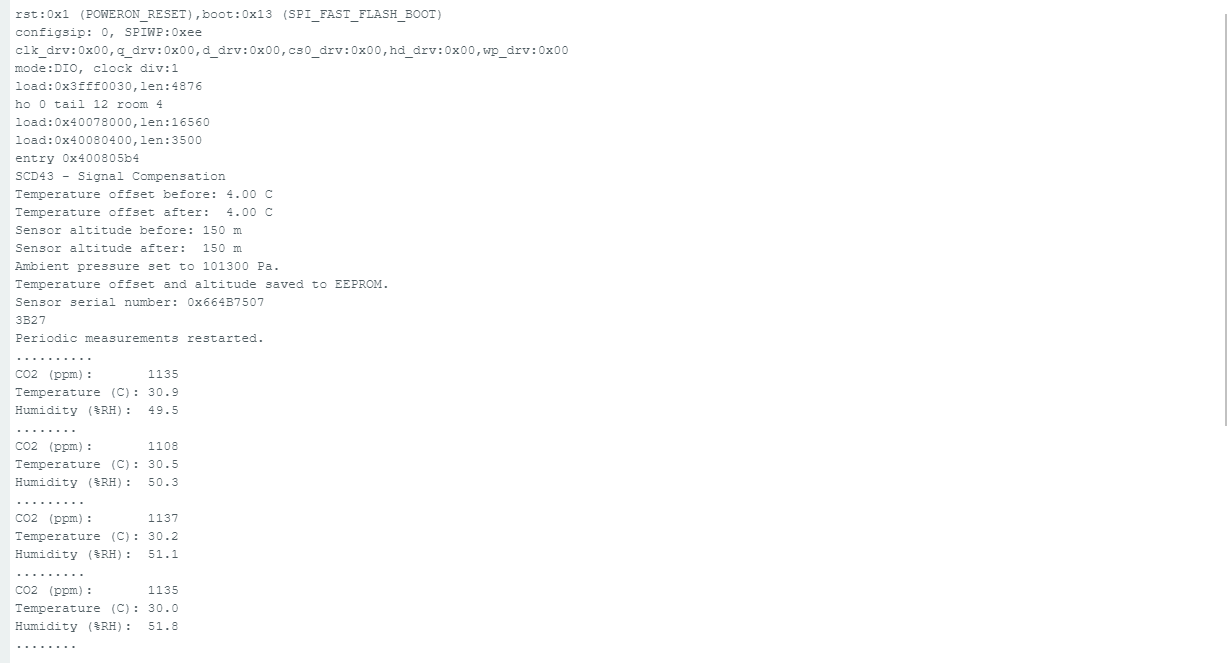
With all three compensation settings applied and periodic measurement resumed, loop() reads and prints CO2, temperature, and humidity exactly the same way as the BasicReadings example. The compensation settings adjust the numbers behind the scenes, they don't change how you read them:
void loop()
{
    if (sensor.readMeasurement())
    {
        Serial.println();
        Serial.print("CO2 (ppm):       ");
        Serial.println(sensor.getCO2());
        Serial.print("Temperature (C): ");
        Serial.println(sensor.getTemperature(), 1);
        Serial.print("Humidity (%RH):  ");
        Serial.println(sensor.getHumidity(), 1);
    }
    else
    {
        Serial.print(".");
    }

    delay(500);
}
Full example
SignalCompensation.ino
Full example sketch for configuring temperature offset, altitude, and ambient pressure compensation on the SCD43.